

Demandan a TacoBell por supuesta publicidad engañosa
Alega que las fotos usadas para promocionar sus productos no son las que finalmente sirven en el restaurante
Presentaron una demanda contra Taco Bell Corp. («Taco Bell») , un abogado en su nombre y en el de todas las demás personas en situaciones similares que compraron Crunchwrap Supreme®, Grande Crunchwrap®, Vegan Crunchwrap®, Mexican Pizza y/o Veggie Mexican Pizza, en un Taco Bell ubicado en Nueva York desde 2020 hasta la fecha.
Se le imputa a la empresa haber incurrido en prácticas comerciales desleales y engañosas por publicitar falsamente la cantidad de carne de res y/o ingredientes contenidos en Crunchwrap Supreme®, Grande Crunchwrap®, Vegan Crunchwrap®, Mexican Pizza y Veggie Mexican Pizza de Taco Bell. elementos de menú (los «Elementos de menú exagerados»).
La demanda alega que los anuncios de Taco Bell para los elementos del menú exagerados son injustos y perjudican financieramente a los consumidores, ya que reciben un producto que tiene un valor materialmente inferior al promocionado, al de la foto de la oferta.
El demandante vio los anuncios de Taco Bell en Internet y en la ubicación de la tienda antes de comprar su pizza mexicana y esperaba que la pizza mexicana que compró tuviera una cantidad similar de relleno de carne de res y frijoles que la que se muestra en las fotografías de la pizza mexicana en Taco Bell. anuncios. Sin embargo, la pizza mexicana que compró el Demandante contenía aproximadamente la mitad del relleno de carne y frijoles que esperaba y se parecía a las imágenes publicadas por otros clientes y citadas en este documento, expresa en su demanda.
Agrega que si el Demandante hubiera sabido que la Pizza Mexicana contenía la mitad de la cantidad de relleno de carne y frijoles que se anuncia, no habría comprado la Pizza Mexicana y/o no habría pagado el precio de $5.49 que pagó por la Pizza Mexicana. El demandante, en su nombre y en el de todos los demás en una situación similar, busca poner fin a la publicidad engañosa.
Regulación de la publicidad engañosa en los Estados Unidos
En Estados Unidos, la principal entidad encargada de supervisar y hacer cumplir las leyes sobre publicidad engañosa es la Comisión Federal de Comercio (FTC). La FTC tiene la autoridad para investigar y tomar medidas contra prácticas publicitarias engañosas a nivel federal.
La Ley de Prácticas Comerciales Engañosas de la FTC prohíbe expresamente las afirmaciones engañosas o falsas en la publicidad, incluyendo afirmaciones sobre los beneficios o características de los alimentos que sean engañosas para el consumidor promedio. Esto incluye afirmaciones sobre los ingredientes, los efectos para la salud, la calidad o el origen del alimento.
En cuanto a precedentes y sentencias relevantes, hay varios casos emblemáticos relacionados con la publicidad engañosa de alimentos en Estados Unidos:
- Caso POM Wonderful LLC v. Comisión Federal de Comercio (2013): En este caso, la compañía POM Wonderful, conocida por sus jugos de granada, fue acusada por la FTC de hacer afirmaciones engañosas y sin respaldo científico sobre los beneficios para la salud de sus productos. La FTC sostuvo que POM Wonderful había hecho afirmaciones falsas sobre la capacidad de sus productos para prevenir o tratar enfermedades, como el cáncer y la disfunción eréctil. Como resultado, se establecieron restricciones sobre las afirmaciones de salud en la publicidad de POM Wonderful, y la compañía estuvo sujeta a la supervisión de la FTC.
- Caso Kellogg’s (2016): Kellogg’s fue objeto de una acción de la FTC debido a las afirmaciones engañosas en la etiqueta de sus barras de cereal «Rice Krispies» que decían que el producto fortalecía el sistema inmunológico. La FTC argumentó que estas afirmaciones no estaban respaldadas por pruebas científicas suficientes y, por lo tanto, eran engañosas para los consumidores. Como resultado del acuerdo, Kellogg’s tuvo que retirar dichas afirmaciones de sus empaques y modificar su publicidad.
- Red Bull (2014). En este caso, Red Bull, una empresa conocida por su bebida energética, fue objeto de una demanda colectiva presentada en 2013. La demanda alegaba que Red Bull había hecho afirmaciones engañosas en su publicidad al afirmar que su bebida podía mejorar el rendimiento físico y mental de los consumidores, y que les proporcionaba beneficios de concentración y energía duradera. Los demandantes argumentaron que estas afirmaciones no estaban respaldadas por pruebas científicas adecuadas.
En 2014, Red Bull llegó a un acuerdo en la demanda colectiva, en el cual acordó pagar hasta 13 millones de dólares en compensación a los miembros de la demanda colectiva. Además, la compañía se comprometió a modificar su publicidad y etiquetado para evitar futuras afirmaciones engañosas sobre los beneficios de su bebida energética.
Este caso es un ejemplo de cómo las demandas colectivas pueden tener un impacto en la industria de alimentos y bebidas, y cómo las empresas pueden ser responsables por prácticas publicitarias engañosas. A través de este acuerdo, Red Bull tuvo que ajustar sus afirmaciones de marketing y proporcionar compensación a los consumidores afectados.
Las demandas colectivas son acciones legales presentadas en nombre de un grupo de individuos que han sido afectados de manera similar por prácticas empresariales engañosas o injustas. En el contexto de la publicidad de alimentos, las demandas colectivas pueden surgir cuando una empresa realiza afirmaciones falsas o engañosas que afectan a un gran número de consumidores.
Las demandas colectivas relacionadas con publicidad engañosa de alimentos generalmente se centran en productos que han sido promocionados con afirmaciones sobre beneficios para la salud, ingredientes, calidad o contenido que resultaron ser falsas o engañosas. Algunos ejemplos comunes de demandas colectivas en este ámbito incluyen:
- Demandas contra fabricantes de alimentos que hacen afirmaciones sobre propiedades saludables de sus productos sin evidencia científica adecuada para respaldar esas afirmaciones.
- Demandas contra empresas que exageran la presencia o cantidad de ciertos ingredientes en sus alimentos, cuando en realidad están en cantidades mínimas.
- Demandas contra empresas que ocultan información importante sobre los posibles efectos adversos para la salud de sus productos.
Demanda a Taco Bell por publicidad engañosa
Case 1:23-cv-05748 Document 1 Filed 07/31/23 Page 1 of 15 PageID #: 1
IN THE UNITED STATES DISTRICT COURT FOR THE EASTERN DISTRICT OF NEW YORK
Case No.:
JURY TRIAL DEMANDED
Frank Siragusa, on behalf of himself and all others similarly situated,
Plaintiff, vs.
Taco Bell Corp.,
Defendant.
CLASS ACTION COMPLAINT
Plaintiff Frank Siragusa, by and through his undersigned counsel, upon personal knowledge as to himself and upon information and belief as to all other matters, allege as follows: 1. Plaintiff brings this action against defendant Taco Bell Corp. (“Taco Bell”), on behalf of himself and all other similarly situated individuals who purchased a Crunchwrap Supreme®, Grande Crunchwrap®, Vegan Crunchwrap®, Mexican Pizza, and/or Veggie Mexican Pizza, from a Taco Bell located in New York during the period July 31, 2020, through the date of
the final disposition of this action.
FACTUAL ALLEGATIONS
2. This is a class action against Taco Bell for unfair and deceptive trade practices for falsely advertising the amount of beef and/or ingredients contained in Taco Bell’s Crunchwrap Supreme®, Grande Crunchwrap®, Vegan Crunchwrap®, Mexican Pizza, and Veggie Mexican Pizza menu items (the “Overstated Menu Items”).


1
Case 1:23-cv-05748 Document 1 Filed 07/31/23 Page 2 of 15 PageID #: 2
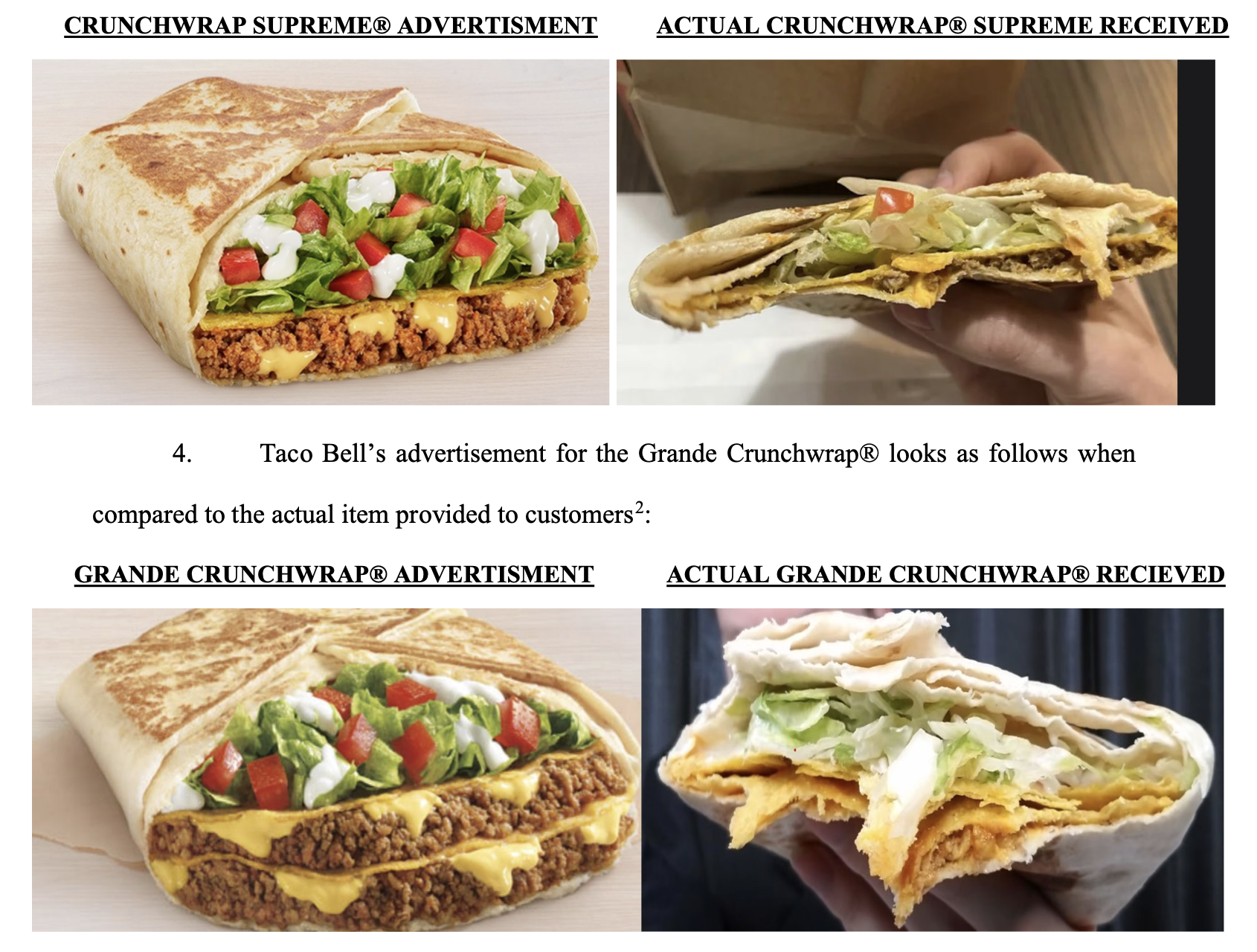
3. Taco Bell’s advertisement for the Crunchwrap Supreme® looks as follows when compared to the actual item provided to customers1:
CRUNCHWRAP SUPREME® ADVERTISMENT ACTUAL CRUNCHWRAP® SUPREME RECEIVED
4. Taco Bell’s advertisement for the Grande Crunchwrap® looks as follows when compared to the actual item provided to customers2:
GRANDE CRUNCHWRAP® ADVERTISMENT ACTUAL GRANDE CRUNCHWRAP® RECIEVED
1The current advertisement for the Crunchwrap Supreme® can be located at
https://www.tacobell.com/food/specialties/crunchwrap-supreme, and the photograph of the actual Crunchwrap Supreme® received by a customer can be located athttps://www.reddit.com/r/tacobell/comments/u6fslk/crunch_wraps_are_a_joke_nowadays/.
2The advertisement for the Grande Crunchwrap Supreme® can be located at https://www.tacobell.com/food/specialties/grande-crunchwrap, and the screenshot of the actual Crunchwrap Supreme® received by a customer can be located at https://youtu.be/ZgsnCUs4S2A?t=445.


2
Case 1:23-cv-05748 Document 1 Filed 07/31/23 Page 3 of 15 PageID #: 3
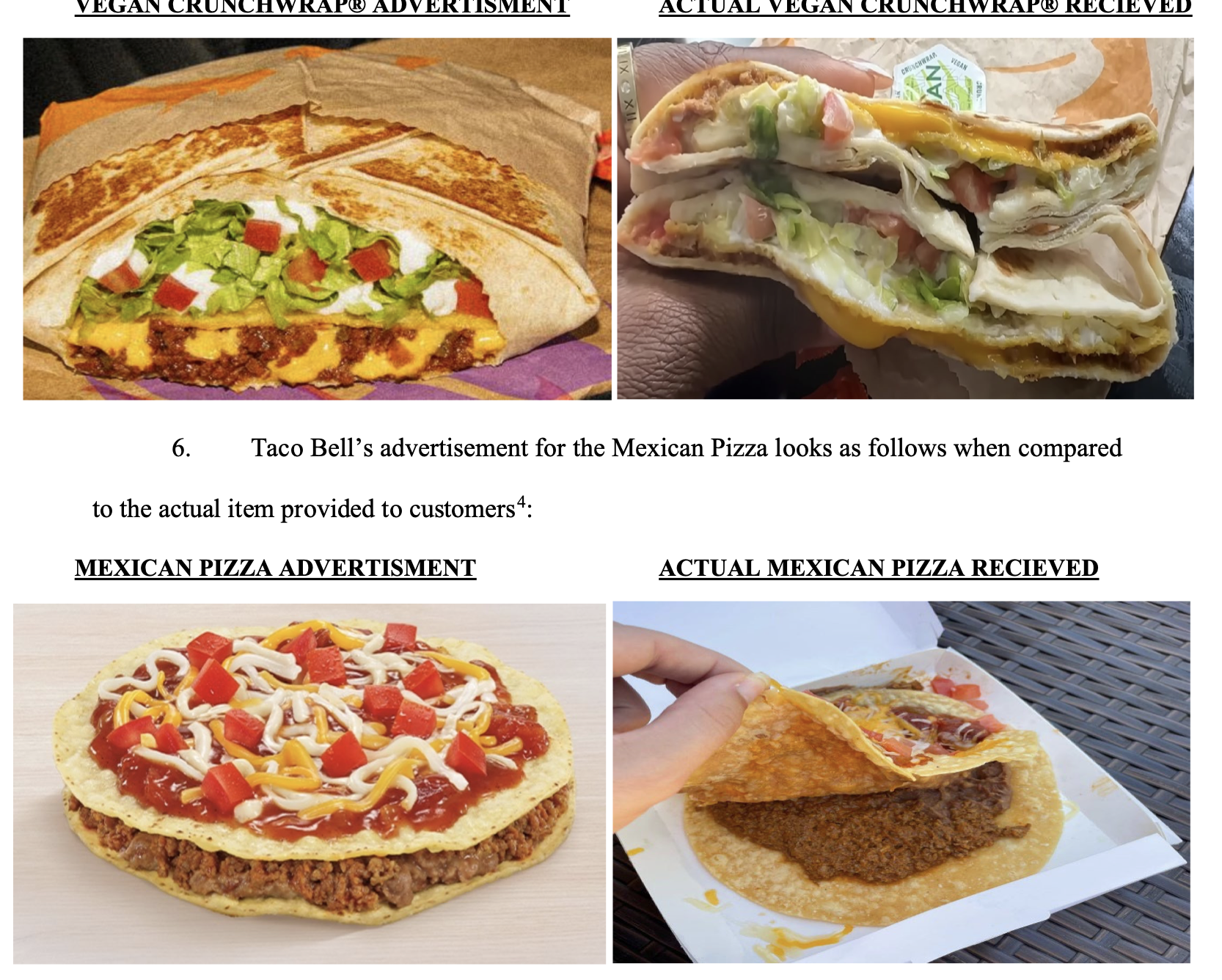
5. Taco Bell’s advertisement for the Vegan Crunchwrap® looks as follows when compared to the actual item provided to customers3:
VEGAN CRUNCHWRAP® ADVERTISMENT ACTUAL VEGAN CRUNCHWRAP® RECIEVED
6. Taco Bell’s advertisement for the Mexican Pizza looks as follows when compared to the actual item provided to customers4:
MEXICAN PIZZA ADVERTISMENT ACTUAL MEXICAN PIZZA RECIEVED
3The advertisement for the Vegan Crunchwrap® can be located at https://www.foodnetwork.com/fn- dish/news/where-to-get-taco-bell-vegan-crunchwrap-supreme, and the screenshot of the actual Vegan Crunchwrap® received by a customer can be located at https://youtu.be/lQZX3qeu2FA?t=83.
4The advertisement for the Mexican Pizza can be located at https://www.tacobell.com/food/specialties/mexican-pizza, and the screenshot of the actual Mexican Pizza received by a customer can be located at https://www.insider.com/review-taco-bell-mexican-pizza-2022-5.


3
Case 1:23-cv-05748 Document 1 Filed 07/31/23 Page 4 of 15 PageID #: 4
7. Taco Bell’s advertisement for the Veggie Mexican Pizza looks as follows when compared to the actual item provided to customers5:
VEGGIE MEXICAN PIZZA ADVERTISMENT ACTUAL VEGGIE MEXICAN PIZZA RECIEVED
8. Taco Bell materially overstates the amount of beef and/or ingredients contained in its advertisements for the Overstated Menu Items by at least double the amount.
9. Taco Bell uses the same uniform photographs on Taco Bell’s in-store and drive- thru menu ordering boards, on the website Tacobell.com, and on food delivery service websites and mobile ordering applications, including Ubereats.com, Postmates.com, Grubhub.com, Seamless.com, and Doordash.com.
10. Taco Bell’s advertisements for the Overstated Menu Items are unfair and financially damaging to consumers as they are receiving a product that is materially lower in value than what is being promised.
5The advertisement for the Veggie Mexican Pizza can be located at
https://www.tacobell.com/food/specialties/veggie-mexican-pizza?store=034922, and the screenshot of the actual Veggie Mexican Pizza received by a customer can be located at https://www.insider.com/review- taco-bell-mexican-pizza-2022-5.


Case 1:23-cv-05748 Document 1 Filed 07/31/23 Page 5 of 15 PageID #: 5
11. Taco Bell’s actions are especially concerning now that inflation, food, and meat prices are very high and many consumers, especially lower income consumers, are struggling financially.
12. Taco Bell’s promise to consumers of a large portion of food with their purchase are also causing consumers to come to, or order from, Taco Bell’s restaurants and make purchases that they would not have otherwise made.
13. Taco Bell is also unfairly competing with restaurants that more fairly advertise the size of their menu items.
14. Taco Bell advertises larger portions of food to steer consumers to their restaurants for their meals and away from competitors that more fairly advertise the size of their menu items, unfairly diverting millions of dollars in sales that would have gone to competitors.
15. On September 15, 2022, a reporter for The U.S. Sun published an article stating that the Mexican Pizza “wasn’t as beefy as the commercial pictures made it look.”6
16. On June 15, 2022, a reporter for Mashed.com published an article stating that many consumers were complaining about the lack of beef in Taco Bell’s Crunchwrap.7
17. Numerous consumers have also posted complaints online. For example, a YouTube food reviewer named Brennen Taylor, who has extensive experience reviewing food items, posted a review of the Mexican Pizza on September 16, 2022, in which he stated that the Mexican Pizza he purchased did not look like the pictures or advertisements. Seehttps://youtu.be/TCEs96yzf5g?t=110.
6 Anthony Russo, PIZZA THAT I tried Taco Bell’s new Mexican pizza as it returns to menu again – it looks NOTHING like the pictures, THE U.S. SUN, September 15, 2022, https://www.the- sun.com/money/6213398/taco-bell-mexican-pizza-review-taste-2/.
7 Colin McCandless, Why Reddit Is Calling Out Taco Bell’s Skimpy Crunchwraps, MASHED, June 15, 2022,https://www.mashed.com/896849/why-reddit-is-calling-out-taco-bells-skimpy-crunchwraps/.


5
Case 1:23-cv-05748 Document 1 Filed 07/31/23 Page 6 of 15 PageID #: 6
18. On October 2, 2022, a YouTube food reviewer with extensive experience reviewing food items, who has a YouTube channel named It’s Birdie!, posted the following YouTube short titled “Taco Bell’s Mexican Pizza Is Not The Same” and she stated that the new Mexican Pizza was smaller than Taco Bell’s original Mexican Pizza and not as thick. Seehttps://www.youtube.com/shorts/1hau9Ny-dl4.
19. On September 20, 2022, Plaintiff purchased a Mexican Pizza at a Taco Bell store located in Ridgewood, New York for $5.49 plus tax.
20. Plaintiff viewed Taco Bell’s advertisements on the internet and at the store location before purchasing his Mexican Pizza and expected the Mexican Pizza that he purchased to contain a similar amount of beef and bean filling as contained in the pictures of the Mexican Pizza in Taco Bell’s advertisements.
21. However, the Mexican Pizza that Plaintiff purchased contained approximately half of the beef and bean filling that he expected and looked like the images posted by other customers and cited herein.
22. If Plaintiff knew that the Mexican Pizza contained half of the amount of beef and bean filling as advertised, he would not have purchased the Mexican Pizza and/or he would not have paid the $5.49 price that he paid for the Mexican Pizza.
23. Plaintiff, on behalf of himself and all others similarly-situated, seek to end Taco Bell’s unfair and materially misleading advertising and request the following: 1) monetary damages fully compensating all individuals who purchased an Overstated Menu Item; 2) injunctive relief requiring Taco Bell to provide corrected advertising and/or to stop selling the Overstated Menu Items; and 3) such other relief as the Court deems necessary and appropriate.

6
Case 1:23-cv-05748 Document 1 Filed 07/31/23 Page 7 of 15 PageID #: 7
THE PARTIES
24. Plaintiff Frank Siragusa is a resident of Ridgewood, New York. During the Class Period (defined below), Mr. Siragusa purchased an Overstated Menu Item at a Taco Bell store located in Ridgewood, New York, within the Court’s district.
25. Defendant Taco Bell System, Inc., is a California corporation, with its headquarters located in Irvine, California. Taco Bell conducts business, directly or indirectly, in New York, under the name Taco Bell®.
JURISDICTION AND VENUE
26. This Court has original diversity jurisdiction over this action under the Class Action Fairness Act, 28 U.S.C. § 1332(d)(2). Plaintiff is a citizen of the State of New York and Defendant Taco Bell is a citizen of the State of California and is headquartered with its principal place of business in the state of California. The matter in controversy exceeds the sum or value of $5,000,000, exclusive of interest and costs, and this is a class action in which the number of members of the proposed class is not less than 100.
27. In addition, this Court has diversity jurisdiction over Plaintiff’s state law claims pursuant to 28 U.S. C. § 1332(a) because the matter in controversy, which includes Plaintiff’s claims and the claims of the proposed class members, exceeds the sum or value of $75,000, exclusive of interest and costs, and certain members of the proposed class are citizens of states different from the states in which Defendant is a citizen.
28. Venue is proper pursuant to 28 U.S.C. § 1391. A substantial part of the events or omissions giving rise to Plaintiff’s claims occurred in this judicial district. Also, Defendant has used the laws within, and has done substantial business in, this judicial district in that it has


7
Case 1:23-cv-05748 Document 1 Filed 07/31/23 Page 8 of 15 PageID #: 8
promoted, marketed, distributed, and sold the products at issue in this judicial district. Finally, there is personal jurisdiction over Defendant in this judicial district.
CLASS ACTION ALLEGATIONS
29. Plaintiff brings this action pursuant to Federal Rules of Civil Procedure 23(a) and 23(b)(2) and (b)(3) on behalf of the following class:
All persons or entities that purchased a Crunchwrap Supreme®, Grande Crunchwrap®, Vegan Crunchwrap®, Mexican Pizza, or Veggie Mexican Pizza, from a Taco Bell, located in the state of New York, during the period between July 31, 2020, through the date of the final disposition of this action (the “Class”).

30.
further investigation reveals that the Class should be expanded or otherwise modified.
Plaintiff reserves the right to amend the definition of the Class if discovery and
- Plaintiff reserves the right to establish additional sub-classes as appropriate.
- This action is brought and properly may be maintained as a class action under the
provisions of Federal Rules of Civil Procedure 23(a)(l)-(4) and 23(b)(2) and (b)(3), and satisfies the requirements thereof.
33. There is a well-defined community of interest among members of the Class, and the disposition of the claims of these members of the Class in a single action will provide substantial benefits to all parties and to the Court.
34. The members of the Class are so numerous that joinder of all members of the Class is impracticable. At this time, Plaintiff believes that the Class includes thousands of members. Therefore, the Class is sufficiently numerous that joinder of all members of the Class in a single action is impracticable under Federal Rule of Civil Procedure Rule 23(a)(l), and the resolution of their claims through the procedure of a class action will be of benefit to the parties and the Court.
8
Case 1:23-cv-05748 Document 1 Filed 07/31/23 Page 9 of 15 PageID #: 9
35. Plaintiff’s claims are typical of the claims of the members of the Class whom he seeks to represent because Plaintiff and each member of the Class has been subjected to the same deceptive and improper practices by Defendant and have been damaged in the same manner.
36. Plaintiff will fairly and adequately represent and protect the interests of the members of the Class as required by Federal Rule of Civil Procedure Rule 23(a)(4). Plaintiff has no interests that are adverse to those of the members of the Class that he seeks to represent. Plaintiff is committed to the vigorous prosecution of this action and, to that end, Plaintiff has retained counsel that is competent and experienced in handling complex class action litigation on behalf of consumers.
37. A class action is superior to all other available methods of the fair and efficient adjudication of the claims asserted in this Complaint under Federal Rule of Civil Procedure 23(b)(3) because:
- The expense and burden of individual litigation would not be economically feasible for members of the Class to seek to redress their claims other than through the procedure of a class action.
- If separate actions were brought by individual members of the Class, the resulting multiplicity of lawsuits would cause members to seek to redress their claims other than through the procedure of a class action; and
- Absent a class action, Defendant likely would retain the benefits of its wrongdoing, and there would be a failure of justice.
38. Common questions of law and fact exist as to the members of the Class, as required by Federal Rule of Civil Procedure 23(a)(2), and predominate over any questions that affect individual members of the Class within the meaning of Federal Rule of Civil Procedure 23(b)(3).
9
Case 1:23-cv-05748 Document 1 Filed 07/31/23 Page 10 of 15 PageID #: 10
- The common questions of fact include, but are not limited to, the following:
- Whether Defendant’s advertisements are materially misleading;
- Whether Defendant engaged in unlawful, unfair, misleading, or deceptivebusiness acts or practices;
- Whether a reasonable consumer could be misled by Defendant’sadvertisements;
- Whether Defendant’s advertisements violate N.Y. Gen. Bus. Law § 350;
- Whether Plaintiff and members of the Class are entitled to an award ofreasonable attorneys’ fees, pre-judgment interest, and costs of this suit.
- In the alternative, this action is certifiable under the provisions of Federal Rule of
Civil Procedure 23(b)(2) because Defendant has acted or refused to act on grounds generally applicable to the Class, thereby making appropriate final injunctive relief or corresponding declaratory relief with respect to the Class as a whole and necessitating that any such relief be
extended to members of the Class on a mandatory, class-wide basis.
41. Plaintiff is not aware of any difficulty that will be encountered in the management
of this litigation that would preclude its maintenance as a class action.
COUNT I
Violation of New York Deceptive Acts and Practices Act, N.Y. Gen. Bus. Law § 349
42. Plaintiff incorporates by reference the allegations in every paragraph in this complaint.
43. New York General Business Law Section 349 (“GBL § 349”) declares unlawful “[d]eceptive acts or practices in the conduct of any business, trade, or commerce or in the furnishing of any service in this state . . .”

10
Case 1:23-cv-05748 Document 1 Filed 07/31/23 Page 11 of 15 PageID #: 11
44. The conduct of Defendant alleged herein constitutes recurring, “unlawful” deceptive acts and practices in violation of GBL § 349, and as such, Plaintiff and the members of the Class seek monetary damages and the entry of preliminary and permanent injunctive relief against Defendant, enjoining it from inaccurately describing, labeling, marketing, and promoting the Overstated Menu Items.
45. Defendant misleadingly, inaccurately, and deceptively presents the Overstated Menu Items to consumers.
46. Defendant’s improper consumer-oriented conduct is misleading in a material way in that it, inter alia, induced Plaintiff and the Class Members to purchase and/or pay a premium for Defendant’s Overstated Menu items when they otherwise would not have. Defendant made its untrue and/or misleading statements and representations willfully, wantonly, and with reckless disregard for the truth.
47. Plaintiff and the members of the Class have been injured inasmuch as they received approximately 100% less than the amount of beef and ingredients that were advertised. Accordingly, Plaintiff and the members of the Class received less than what they bargained and/or paid for.
48. Plaintiff and the members of the Class suffered damages amounting to the price that Taco Bell charges consumers for double the meat and/or ingredients, the exact amount to be determined at trial.
49. Defendant’s deceptive and misleading practices constitute a deceptive act and practice in the conduct of business in violation of New York General Business Law §349(a) and Plaintiff and the members of the Class have been damaged thereby.
11
Case 1:23-cv-05748 Document 1 Filed 07/31/23 Page 12 of 15 PageID #: 12
50. As a result of Defendant’s recurring, “unlawful” deceptive acts and practices, Plaintiff and the members of the Class are entitled to monetary, compensatory, statutory, and treble damages, interest, and attorneys’ fees and costs. This includes actual damages under GBL § 349, as well as statutory damages of $50 per unit purchased pursuant to GBL § 349.

51. complaint. 52.
COUNT II
Violation of New York Deceptive Acts and Practices Act, N.Y. Gen. Bus. Law § 350
Plaintiff incorporates by reference the allegations in every paragraph in this
N.Y. Gen. Bus. Law § 350 provides, in part, as follows:
The term “false advertising” means advertising, including labeling, of a commodity, or of the kind, character, terms or conditions of any employment opportunity if such advertising is misleading in a material respect. In determining whether any advertising is misleading, there shall be taken into account (among other things) not only representations made by statement, word, design, device, sound or any combination thereof, but also the extent to which the advertising fails to reveal facts material in the light of such representations with respect to the commodity or employment to which the advertising relates under the conditions prescribed in said advertisement, or under such conditions as are customary or usual.
Defendant’s advertisements contain untrue and materially misleading statements
53.
concerning the amount of beef and/or ingredients contained in the Overstated Menu Items.
54. Defendant’s advertising induced Plaintiff and the members of the Class to buy Defendant’s menu items.
55. Defendant made its untrue and/or misleading statements and representations willfully, wantonly, and with reckless disregard for the truth.
56. Defendant’s conduct constitutes multiple, separate violations of N.Y. Gen. Bus. Law § 350.
12
Case 1:23-cv-05748 Document 1 Filed 07/31/23 Page 13 of 15 PageID #: 13
57. Defendant’s material misrepresentations were substantially uniform in content, presentation, and impact upon consumers at large. Moreover, all consumers purchasing the Overstated Menu Items were and continue to be exposed to Defendant’s material misrepresentations.
58. Plaintiff and the members of the Class have been injured inasmuch as they received approximately 100% less than the amount of beef and/or ingredients that were advertised. Accordingly, Plaintiff and the members of the Class received less than what they bargained and/or paid for.
59. Plaintiff and the members of the Class suffered damages amounting to the price that Taco Bell charges consumers for double the meat and/or ingredients, the exact amount to be determined at trial.
60. As a result of Defendant’s recurring, “unlawful” deceptive acts and practices, Plaintiff and the members of the Class are entitled to monetary, compensatory, statutory, and treble damages, interest, and attorneys’ fees and costs, as well as statutory damages of $500 per unit purchased.
RELIEF REQUESTED
61. Accordingly, Plaintiff, on behalf of himself and the members of the Class, seek judgment as follows:
A. Certifying the Class as requested herein, certifying Plaintiff as the representative of the Class, and appointing Plaintiff’s counsel as counsel for the Class;
B. Ordering that Defendant is financially responsible for notifying all members of the Class of the alleged misrepresentations and omissions set forth herein;

13
Case 1:23-cv-05748 Document 1 Filed 07/31/23 Page 14 of 15 PageID #: 14
C. Awarding Plaintiff and the members of the Class statutory damages or compensatory damages in an amount according to proof at trial;
D. Awarding declaratory and injunctive relief, including: enjoining Defendant from continuing the unlawful practices as set forth herein, and directing Defendant to identify, with Court supervision, victims of their conduct and pay them restitution and disgorgement of all monies acquired by Defendant by means of any act or practice declared by this Court to be wrongful or unlawful;
E. Ordering Defendant to stop selling Overstated Menu Items or to correct the deceptive behavior;
F. Awarding interest on the monies wrongfully obtained from the date of collection through the date of entry of judgment in this action;
G. Awarding attorneys’ fees, expenses, and recoverable costs reasonably incurred in connection with the commencement and prosecution of this action; and
H. Directing such other and further relief as the Court deems just and proper.
DEMAND FOR JURY TRIAL
Pursuant to Rule 38(b) of the Federal Rules of Civil Procedure, Plaintiff and the Class demand a trial by jury as to all matters so triable.


Dated: July 31, 2023
Los comentarios están cerrados, pero trackbacks Y pingbacks están abiertos.